Study Optimization

Study Optimization : Learn smarter, not harder. We share techniques that help engineering students cut study time, boost focus, and create space for innovation outside the classroom.

Learning on the fly
Efficient, Productivity, Study Optimization

Learning on the Fly: A Superpower for Engineering Students and Its Link to AI

Learning on the Fly: A Superpower for Engineering Students and Its Link to AI In our fast-paced world, the ability to “learn on the fly” is essential to stand out in any industry. It’s the capacity to quickly adapt and acquire new skills or knowledge when facing unexpected challenges. As engineering students, we often grapple with complex subjects, making this skill difficult to cultivate, yet it is crucial and a key to mastering the topics we study. What Exactly is “Learning on the Fly”? Learning on the fly is a straightforward concept that can be easily explained through these points: Openness to Change: We naturally shy away from problems we face while studying a subject. However, learning on the fly means being ready for new problems and courageously seeking solutions. There’s no fear of wasted time because every effort is 100% beneficial. Experience-Based Learning: This involves improving through direct successes and failures. It takes time, but it’s absolutely worth the effort. Intellect over Knowledge: It’s about understanding *how* information connects and works (true intelligence) instead of just memorizing facts. Imagine the subject you’re learning as a map. After completing it the traditional way, this map might have some unknown areas that connect different lands. These “unknown places” are the valuable insights you gain through learning on the fly. Adaptability in Action: To master the “learning on the fly” skill, you need to be flexible and willing to experiment. This gives you the freedom to learn new things without constraint. Humility: Recognizing that you don’t have all the answers and learning from mistakes. Accepting this fact will naturally enable your mind to absorb and adapt more information effectively. Why “Learning on the Fly” is Your Superpower This dynamic skill provides significant advantages, especially for engineering students: Career Advancement: It opens doors to new opportunities and projects. Learning new things consistently leads to more innovative ideas, a better mindset, and a wider imagination. Relevance: It keeps you competitive in rapidly evolving industries. As mentioned, this skill is not common among engineers, so acquiring it will undoubtedly make you much more distinguished compared to your peers. Problem-Solving: It equips you to tackle never-before-seen issues. Being flexible and fast to adapt to situations and problems is a very rare and crucial ability. Being able to solve new problems better and faster than others is truly rewarding. Knowledge Boost: It expands your understanding across various fields, broadening your vision within your acquired knowledge. Cultivating the Mindset of Learning on the Fly Here are practical strategies to become an expert at learning on the fly: Sharpen Your Axe (Prepare): Before you start, set some clear goals. Think of a big skill like a huge mountain. Instead of trying to climb it all at once, break it down into smaller, manageable hills. And don’t be afraid to find a guide or a friend who’s already been there to show you the way. Optimize Your Focus: Find your perfect learning spot—a place where distractions can’t reach you. You can start with the “Five-Minute Rule”: just commit to five minutes of work. You’ll often find yourself going for much longer, and it’s a great way to trick your brain into starting. Learn by Doing: Real learning doesn’t happen just by reading. It happens when you jump in and get your hands dirty. Find a project or a real-life situation where you can use what you’re learning. This is where things truly click. Target Weaknesses (80/20 Rule): We all have areas where we’re not as strong, and that’s perfectly okay. Instead of just doing what’s easy, focus on the areas that challenge you the most. This is where the biggest improvements happen; it’s like finding the weak point in a chain and making it stronger. Test Relentlessly: Don’t just read something and hope it sticks. Test yourself constantly. Use questions to pull the information out of your brain. And don’t shy away from tasks that feel a little too difficult—that’s how you stretch your mind and truly learn. Seek Feedback: A good guide or friend can often see things you can’t. Ask for their honest feedback and use it to improve. Mistakes aren’t failures; they’re valuable hints telling you where to go next. Space Out Learning: Our brains tend to forget things over time. To counteract this, review what you’ve learned a little bit at a time, with increasing intervals in between. This helps the knowledge sink in deep, ensuring you don’t forget it later. Overlearn for Deeper Understanding: Instead of just learning the “what,” always ask “why.” When you understand the main ideas and principles behind a topic, you can connect it to everything else. This makes learning new things in that area much easier. Teach to Learn: The best way to ensure you truly understand something is to try to explain it to someone else. If you can teach it, you’ve mastered it. Plus, learning from someone who is just a step ahead of you is often more helpful than learning from a guru who might be too advanced to relate to your immediate needs. Balance Theory and Practice: It’s easy to get lost in books and articles (theory overload). To avoid this, make sure you’re spending enough time actually practicing. A good rule is to practice at least five hours for every one hour of theory. This balance ensures your new skills become second nature. The Dynamic Relationship Between Learning on the Fly and AI When developing advanced generative AI agents, programmers apply the “learning on the fly” concept to their AI models to teach them broadly. This approach helps the AI interact better with problems it needs to solve, making it more flexible and innovative in its responses. While our human analysis, ethical judgment, and understanding of bias are irreplaceable, especially for high-stakes decisions, AI can compensate for this disadvantage by learning from every piece of information it encounters. Conclusion:  “Learning on the fly” is more than just a skill; it’s like discovering a new
AI NOTE TAKING FAIL
Efficient, Study Optimization

WHY DOES AI NOTE-TAKING FAIL ?

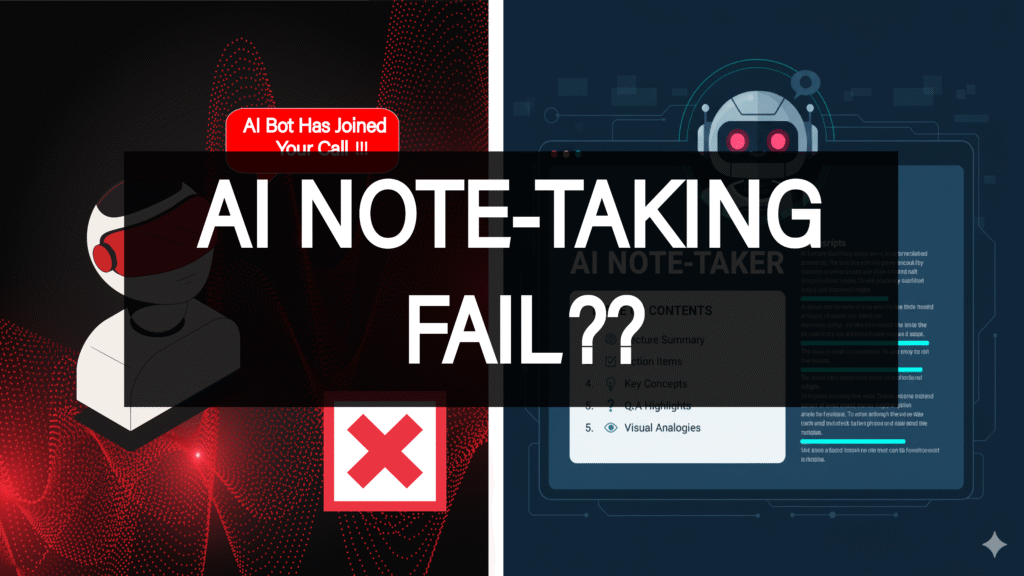
WHY DOES AI NOTE-TAKING FAIL ? Why Standard AI Note-Taking Fails ? Let’s be honest: finding an AI note-taker that actually helps rather than harasses feels almost impossible. The frustration is real, you try a new tool hoping for structured notes, but what do you get? The Spy Bot: A tool that demands to join your most sensitive meetings. As one user put it: “Otter bot randomly joins my calls, not cool.” The privacy invasiveness of tools that automatically join calls and upload to the cloud is a constant concern. The Garbage Summary: You spend an hour in a meeting only to receive a summary that is “not useful beyond the transcript.” Many tools simply paraphrase the raw text instead of extracting real insights or actionable items. The Accent Barrier: If you or your colleagues have anything other than a generic American or British accent, the transcription quality plummets. Most AI models still fail with Indian, Chinese, or African accents, a major systemic issue. We hear you. That’s why we filtered the field to find tools that prioritize your control, your privacy, and your ability to be understood. Example of a user experience: “Otter bot randomly joins my calls, not cool.” Why Is AI Note-Taking Essential in 2025? Whether you are a student or a professor, you’re missing out on valuable time and efficiency in studying or tutoring if you’re not using an AI note-taker. It’s simply essential in 2025 for navigating fast lectures, online resources, and exam preparation. What Students Use AI Note-Takers For ? Through research into how people and students use AI note-takers, it’s clear that these tools make learning faster and more intuitive. They help you digest knowledge by structuring information clearly. AI models can break down a general topic into multiple subtopics, allowing you to approach each separately instead of trying to grasp everything at once. Another example many have noticed when using generative AI is its ability to create comparison tables that make a huge difference in understanding concepts. AI models are also great at visualizing information, many users have experienced how helpful visual analogies from AI can be. AI also promotes active learning. Instead of passively reading content, you can treat the AI notetaker as a professor, ask it questions, dive deeper into details, and truly understand the subject. AI note-takers are also extremely useful for long-term memorization. They act as external drives that retain structured information, allowing you to revisit it anytime. A tool like Notion AI, for instance, can adapt to your preferred memorization method and organize information accordingly. Pro Tip: An AI note-taker can help you build your own knowledge database to later craft blog posts, YouTube videos, or code notebooks, content you can publish and share with your community. Methodology: How I Selected the Best AI Note-Taking Tools Our selection process wasn’t based on marketing claims but on user feedback, technical specifications, and security audits. We analyzed dozens of tools based on three critical user-centric requirements to ensure our recommendations go beyond “just getting a transcript.” Priority 1: Data Sovereignty and Privacy The primary filter was user control. Users consistently flag tools that automatically join calls (like the problematic “Otter bot”) or permanently store sensitive data in the cloud as intrusive or non-compliant. We prioritized tools based on the following criteria: Local/Offline Functionality: Does the data stay on your machine? (e.g., Granola, Hyprnote, Obsidian, Joplin) Explicit Privacy Guarantees: Tools like Jamie were prioritized for deleting audio after transcription and not storing data on third-party servers. Open Source/Encryption: Tools offering self-hosting and end-to-end encryption (Joplin). Priority 2: Unwavering Accuracy and Clarity Generic transcription quality isn’t enough, especially when models fail with diverse accents such as Indian, Chinese, or African. We prioritized tools demonstrating strong performance in complex audio environments: Accent Handling: Tools noted for high accuracy across multiple languages (Sonix, Notta, Speechmatics). Speaker Separation (Diarization): Identifying multiple speakers accurately is crucial for searchability (Krisp, Vomo AI, Tactiq). Flexibility: Support for manual audio uploads (Jamie, Sonix, Notta, Granola). Priority 3: Genuine Insights, Not Paraphrasing Many tools produce weak summaries that simply restate transcripts. We focused on tools offering fast automation, actionable items, and structured output. Those with cross-platform support and deep integrations (Notion, Slack, etc.) scored higher for minimizing “storage lock-in.” Privacy Problem Solution Tools If privacy is your top priority, and for sensitive client or medical work, it must be, avoid mandatory cloud storage. We found several tools designed specifically to keep your data contained: Joplin & Obsidian: The gold standard for control. Joplin is fully open-source and supports end-to-end encryption (E2EE) and self-hosted sync. Obsidian keeps your notes local, using community plugins for AI features so your data never leaves your device. Jamie: Privacy-first design with no meeting bots. Data is deleted after transcription, and audio is never stored on third-party servers. Hyprnote: Performs local processing only, ensuring sensitive data never leaves your device, HIPAA and GDPR compliant. Best and Most Used AI Note-Takers NotebookLM (Google): Built on Gemini; transforms readings and recordings into summaries, audio overviews, quizzes, and flashcards, making it a complete study companion.Con: Advanced features tied to paid tiers; limited support for handwriting. Notion AI: Combines productivity with smart note-taking as an all-in-one workspace for lectures, projects, and tasks. Offers AI summarization, writing, and research modes.Con: Full AI features require Business or Enterprise plans; not built for live audio transcription. Otter.ai: Excellent real-time transcription for lectures and meetings, creating searchable transcripts with summaries and speaker identification.Con: Free tier time limits; lacks advanced study features. MeetGeek: Designed for meeting transcription and summaries; works well for recorded lectures and produces clear bullet-point notes.Con: Built for business first, not optimized for education. PolarNotes AI: A leading note-taker for students and teachers, organizing lectures, slides, and documents into outlines, flashcards, and interactive quizzes.Con: Focused primarily on educational use. Evernote AI: Enhances classic note-taking with AI summarization and editing for typed notes, web clippings, and PDFs.Con: Limited audio/handwriting support; restricted free tier. Coconote: Built for student workflows; converts lectures into

language tips
Study Optimization

Fluent in German, Confident in Class: Language Tips for Engineering Students in Germany

Fluent in German, Confident in Class: Language Tips for Engineering Students in Germany Why Is Speaking German with Others Hard?​ Here’s a list that gives you a clear view of what makes speaking German with others difficult:  Complex Sentences and Long Words German often uses complex sentence structures and long compound words. For example: German Word Meaning in English Krankenversicherung Health insurance Geschwindigkeitsbegrenzung Speed limit Zahnärztliche Untersuchung Dental check-up It’s Hard to Form Sentences Quickly You always have to think about placing the verb at the end of the sentence, which slows down your speech. Verb Tenses Are Challenging One of the hardest parts is using the correct verb tense: Perfekt, Präteritum, Konjunktiv II, and so on. Adjective Endings and Articles Another big problem is writing adjectives correctly especially knowing which article (der, die, das) fits each word. Case Confusion: Nominative, Accusative, Dative, or Genitive? This is a widespread issue for learners. You’re not alone! Choosing the Right Words and Expressions Sometimes, it’s hard to know which words or expressions to use, especially for things like probability or wishes. Examples: ob, wenn, wünschen, damit, um zu, etc. What Are the Basic Methods to Improve Speaking? Listen to a lot of German: podcasts, YouTube videos, etc. This will help you understand better and faster, and teach you which sentences are commonly used by native speakers.   Find a language partner: Look for study groups on platforms like Discord or Telegram. This improves your reflexes when answering and discussing.   Read anything in German: Stories, comics, etc. This helps you naturally adapt to the language.   Watch films: Make a list of pure German-language films. Films help you see how people react when speaking their expressions and body language.   Listen to the news: Make it a short daily habit no more than 30 minutes. You’ll learn political vocabulary and gain insight into how the German people view the world Special Key methods ( daily routine ) Adapt it as a life routine: every 30 minutes of your day must include German. That might sound awkward now, but it will become possible and automatic with these methods: Listen to spoken German that’s close to street language: news segments where people are interviewed, podcasts, or vlogs. Talk to yourself in the mirror, out loud, and record yourself. Imitate the intonation and pronunciation of the German words you heard in podcasts. Force yourself to integrate. Yes, you might feel stupid at first, but those embarrassing moments will give you the drive to speak. Your body will react on its own -believe me. Label everything in your house with sticky notes, and say the word every time you use the object. You won’t struggle to remember it anymore.  Roleplay Your Day in German Narrate your actions and thoughts in German as you go through your day, like a monologue: “Ich mache mir einen Kaffee.” (I’m making myself a coffee.) “Wo sind meine Schlüssel?” (Where are my keys?) You can even do this in your head if you’re in a public place! Keep a German-Only Diary Write a short journal entry in German every day. Start simple just a few lines about your day, thoughts, or plans. Use a dictionary when needed. Over time, you’ll notice patterns in your grammar and vocabulary.  Follow German Recipes Cook German dishes using recipes written in German. You’ll learn food-related vocabulary and instructions, and experience German culture through cuisine. Start with something simple like Kartoffelsalat (potato salad) or Apfelstrudel.  Play German Board or Video Games Play games in German either physical games with German instructions (like Codenames or Scrabble in German), or switch the language of your favorite video games. Many learners improve significantly just by gaming in their target language.  Take a “German City Walk” with Google Street View Pick a German-speaking city (Berlin, Munich, Vienna, Zurich) and “walk around” using Google Street View. Look at store signs, advertisements, menus, posters anything in the environment. You can even pretend you’re giving a tour in German.  Use the Shadowing Technique Find a German podcast or audio recording and try to repeat every word in real time with the speaker. Mimic pronunciation and intonation. It’s like doing vocal push-ups —great for speaking fluency and accent.  Read Children’s Books or Comics in German They’re simple, fun, and visual. Try Der kleine Prinz (The Little Prince) or comics like Asterix in German. You’ll learn natural sentence structures and vocabulary in context, without feeling overwhelmed. Turn Your Environment into a Puzzle Put sticky notes or flashcards with only the German word (no native language) on items around your home. Create games to test yourself daily: “Find 5 objects that start with ‘S’ in German.” Change the words weekly to expand your vocabulary.  Teach Someone Else Teaching forces you to explain concepts clearly. Try explaining German grammar rules, words, or phrases to a friend (even if they’re not learning). If no one is available, pretend you’re teaching a lesson to an imaginary class.  Watch German with NO Subtitles Challenge yourself with short scenes or episodes without subtitles. Your brain will work harder to infer meaning from tone, body language, and context. Then rewatch with German subtitles to confirm your understanding.  Dream in German (Yes, Really!) Right before bed, review a few German words or sentences. Your brain might process that input overnight, and yes, many learners have reported dreaming in their target language after doing this consistently. I’m still personally on my way to speaking Deutsch fluently. I’m already at a B2 level with a TELC certificate. Working with these methods is helping me move forward quickly on my learning path. Real life experiences of real people :   Previous PostNext Post Popular Posts Top 7 AI writing tools for Engineering Students Top AI Posting Tools Every Engineering Student Should Use to Be Innovative Without Design Skills Best AI Video Editing & Graphic Design Tools for Engineering Student Living in Germany as Engineering Student : Why is it hard living in Germany without speaking