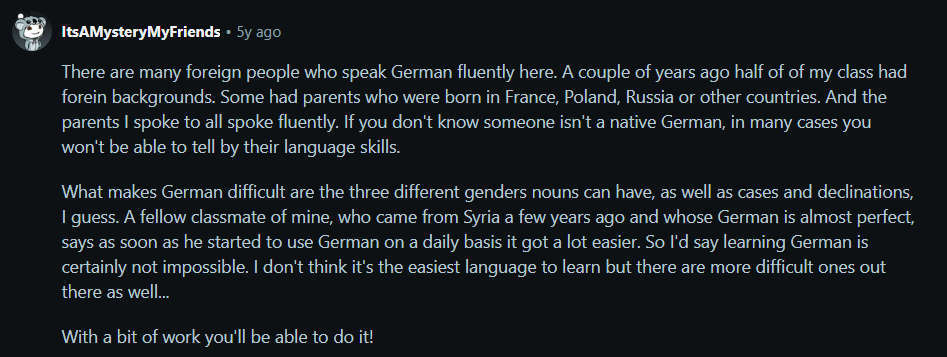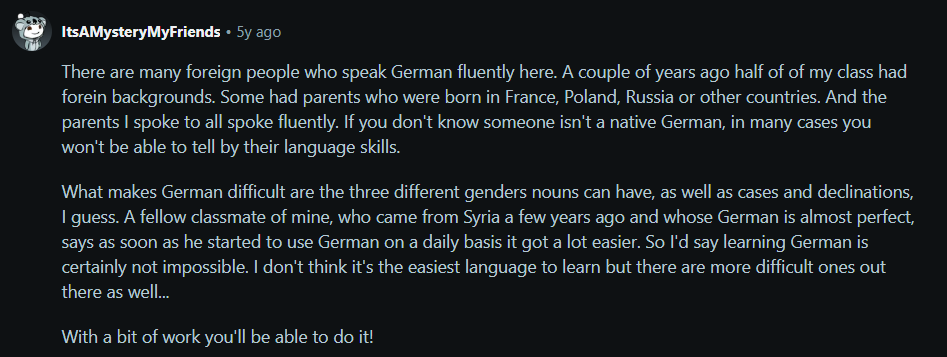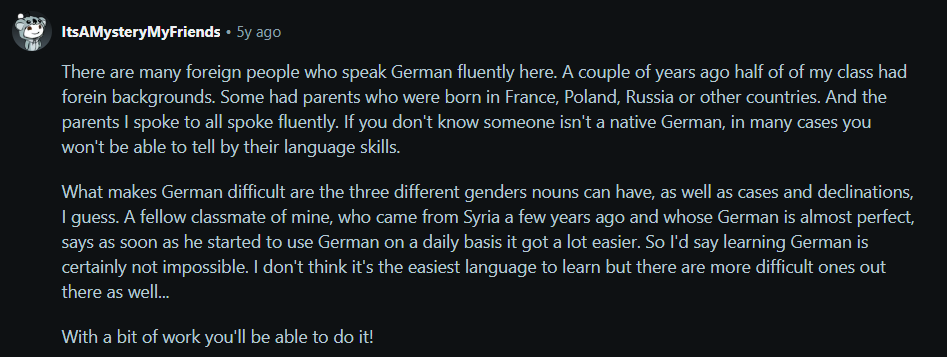
Why Is Speaking German with Others Hard?
Here’s a list that gives you a clear view of what makes speaking German with others difficult:
- Complex Sentences and Long Words
German often uses complex sentence structures and long compound words. For example:
German Word | Meaning in English |
Krankenversicherung | Health insurance |
Geschwindigkeitsbegrenzung | Speed limit |
Zahnärztliche Untersuchung | Dental check-up |
- It’s Hard to Form Sentences Quickly
You always have to think about placing the verb at the end of the sentence, which slows down your speech.
- Verb Tenses Are Challenging
One of the hardest parts is using the correct verb tense:
Perfekt, Präteritum, Konjunktiv II, and so on.
- Adjective Endings and Articles
Another big problem is writing adjectives correctly especially knowing which article (der, die, das) fits each word.
- Case Confusion: Nominative, Accusative, Dative, or Genitive?
This is a widespread issue for learners. You’re not alone!
- Choosing the Right Words and Expressions
Sometimes, it’s hard to know which words or expressions to use, especially for things like probability or wishes.
Examples: ob, wenn, wünschen, damit, um zu, etc.
What Are the Basic Methods to Improve Speaking?
- Listen to a lot of German: podcasts, YouTube videos, etc.
This will help you understand better and faster, and teach you which sentences are commonly used by native speakers. - Find a language partner:
Look for study groups on platforms like Discord or Telegram.
This improves your reflexes when answering and discussing. - Read anything in German:
Stories, comics, etc. This helps you naturally adapt to the language. - Watch films:
Make a list of pure German-language films.
Films help you see how people react when speaking their expressions and body language. - Listen to the news:
Make it a short daily habit no more than 30 minutes.
You’ll learn political vocabulary and gain insight into how the German people view the world
Special Key methods ( daily routine )
Adapt it as a life routine: every 30 minutes of your day must include German.
That might sound awkward now, but it will become possible and automatic with these methods:- Listen to spoken German that’s close to street language: news segments where people are interviewed, podcasts, or vlogs.
- Talk to yourself in the mirror, out loud, and record yourself. Imitate the intonation and pronunciation of the German words you heard in podcasts.
- Force yourself to integrate. Yes, you might feel stupid at first, but those embarrassing moments will give you the drive to speak. Your body will react on its own -believe me.
- Label everything in your house with sticky notes, and say the word every time you use the object. You won’t struggle to remember it anymore.
Roleplay Your Day in German
Narrate your actions and thoughts in German as you go through your day, like a monologue:
“Ich mache mir einen Kaffee.” (I’m making myself a coffee.)
“Wo sind meine Schlüssel?” (Where are my keys?)You can even do this in your head if you’re in a public place!
Keep a German-Only Diary
Write a short journal entry in German every day. Start simple just a few lines about your day, thoughts, or plans. Use a dictionary when needed. Over time, you’ll notice patterns in your grammar and vocabulary.
Follow German Recipes
Cook German dishes using recipes written in German. You’ll learn food-related vocabulary and instructions, and experience German culture through cuisine. Start with something simple like Kartoffelsalat (potato salad) or Apfelstrudel.
Play German Board or Video Games
Play games in German either physical games with German instructions (like Codenames or Scrabble in German), or switch the language of your favorite video games. Many learners improve significantly just by gaming in their target language.
Take a “German City Walk” with Google Street View
Pick a German-speaking city (Berlin, Munich, Vienna, Zurich) and “walk around” using Google Street View. Look at store signs, advertisements, menus, posters anything in the environment. You can even pretend you’re giving a tour in German.
Use the Shadowing Technique
Find a German podcast or audio recording and try to repeat every word in real time with the speaker. Mimic pronunciation and intonation. It’s like doing vocal push-ups —great for speaking fluency and accent.
Read Children’s Books or Comics in German
They’re simple, fun, and visual. Try Der kleine Prinz (The Little Prince) or comics like Asterix in German. You’ll learn natural sentence structures and vocabulary in context, without feeling overwhelmed.
Turn Your Environment into a Puzzle
Put sticky notes or flashcards with only the German word (no native language) on items around your home. Create games to test yourself daily: “Find 5 objects that start with ‘S’ in German.” Change the words weekly to expand your vocabulary.
Teach Someone Else
Teaching forces you to explain concepts clearly. Try explaining German grammar rules, words, or phrases to a friend (even if they’re not learning). If no one is available, pretend you’re teaching a lesson to an imaginary class.
Watch German with NO Subtitles
Challenge yourself with short scenes or episodes without subtitles. Your brain will work harder to infer meaning from tone, body language, and context. Then rewatch with German subtitles to confirm your understanding.
Dream in German (Yes, Really!)
Right before bed, review a few German words or sentences. Your brain might process that input overnight, and yes, many learners have reported dreaming in their target language after doing this consistently.
I’m still personally on my way to speaking Deutsch fluently. I’m already at a B2 level with a TELC certificate.
Working with these methods is helping me move forward quickly on my learning path.
Real life experiences of real people :